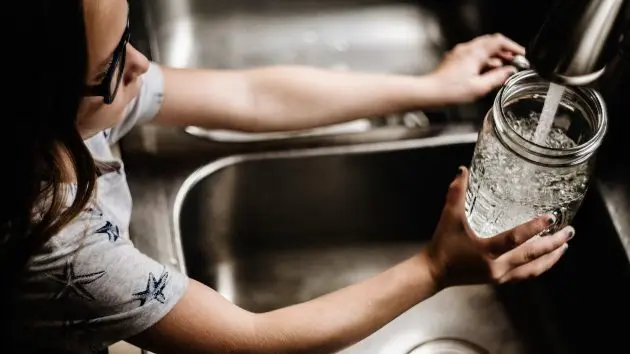
(NEW YORK) — Turning on the tap for a glass of water or to wash produce may become significantly less predictable because of climate change.
According to a study published in Communications Earth & Environment, climate change is making access to drinkable water more difficult in the United States.
Hazards intensified by climate change, like drought and flooding, threaten both the quantity and quality of drinking water across the U.S., according to the study.
As a result, water utilities serving 67 million customers across the U.S. are at high risk from climate hazards, roughly a fifth of the entire U.S. population.
Looking at 1,500 municipal water utilities across the country, researchers found that water utilities in every U.S. region are vulnerable to climate hazards. While drought impacts water utilities in the Western states more directly, saltwater from coastal flooding worsens groundwater quality, and extreme cold can wear on pipes. Additionally, water utilities in the upper Midwest and Northeast are particularly vulnerable to climate hazards due to older infrastructure.
“Much of our infrastructure was built many decades ago,” Costa Samaras, professor of civil environmental engineering at Carnegie Mellon University and co-author of the study, told ABC News. “It was built not for the climate that we’re experiencing now.”
Given the age of existing infrastructure and lack of adaptive capacities, water utilities are less likely to quickly recover from increasingly common climate hazards. According to the study, water utilities are already experiencing higher operating expenses and more revenue lost from hazards.
The study found that some of the largest water utilities in the country are also some of the most vulnerable to climate hazards. In Texas, where the most vulnerable utilities serve a growing number of customers, more investments in water utility infrastructure are key to keeping up with the increasing population.
To make matters worse, most drinking water utilities in the U.S. are not financially planning for future climate risks. As water utility companies try to keep their costs down, short-term emergency fixes are prioritized in order to resume service while investments to prevent more extreme future hazards get put on the back burner.
“When you’re not thinking strategically about asset management and long-term planning, it’s really easy to become stuck in a negative financial loop,” said Zia Lyle, postdoctoral researcher at the University of North Carolina at Chapel Hill and co-author of the study. Intensifying climate risks create larger financial burdens on utility companies to maintain service, limiting investments in future resilient infrastructure.
In addition to poor asset management, the study found that bond disclosures for the municipal water utilities do not typically include information on climate risks.
“The lack of disclosure here indicates a real systematic lack of climate risk assessments,” said Lyle. “When we interviewed drinking water utility managers, some of them were just unaware of how this range of hazards can affect all the different aspects of their system.”
Though it is becoming more common, only 30% of utilities discussed climate change in their bond statements in 2024. Without disclosure, those buying municipal bonds are left unaware of the risks their drinking water utilities face. In six states alone — Michigan, Illinois, California, Massachusetts, Virginia, and Texas — bond debt is currently around $500 million. Paired with decreased funding from the federal government, the lack of assessment and disclosure only increases the financial strain on drinking water utilities.
As climate hazards intensify, the financial risk combined with climate risks puts millions of customers and water utilities in a vulnerable position.
Some states are addressing the risks their drinking water utilities face. In Colorado, Denver Water is currently assessing the risks drought poses to their utilities so that they can plan appropriately and ensure water for their customers in the future.
Between appropriate risk assessment and increased investment from the state and federal governments, ensuring future access to drinking water is still possible.
“Now is the time for systems to invest,” said Dr. Zyle. “Overall, capital is more affordable now, and they can make these investments before it becomes too expensive.”
Copyright © 2026, ABC Audio. All rights reserved.