(NEW YORK) — Several developments came out of Washington, D.C., regarding the war with Iran over the weekend as strikes continue across the Middle East and economic impacts are beginning to be felt domestically.
President Donald Trump and administration officials continued to comment on the timeline of the war, the possibility of a deal with Iran, securing the Strait of Hormuz and the release of oil reserves.
The administration has maintained that the U.S. is decimating Iranian forces and degrading their capabilities, but Iran continues to strike.
On Saturday, Trump said on social media, “We have already destroyed 100% of Iran’s Military capability,” and said the U.S. “will soon get the Hormuz Strait OPEN, SAFE, and FREE.”
Still, the administration has yet to comment on the deployment of Marines to the region, which was announced on Friday, and what their mission could entail.
Trump also faced backlash over the weekend after an affiliated political action committee sent a fundraising email, featuring a photo from the dignified transfer of the first six U.S. service members killed in the Iran war, while offering contributors access to “private national security briefings.”
ABC News has compiled a list of some of the latest developments as the war stretches into its third week.
Timeline
Questions continue to swirl about how long Trump wants the United States to be engaged in this war.
He spent the bulk of last week assuring Americans it would be over soon, hoping to ease market concerns, saying Iran is beaten. But on his way out of Washington Friday night, he refused to comment on how long it would continue. “As long as necessary,” Trump said.
On Sunday, Energy Secretary Chris Wright told ABC News’ Martha Raddatz, “I think that this conflict will certainly come to an end in the next few weeks. Could be sooner than that, but the conflict will come to the end in the next few weeks.”
In an interview with NBC, Wright also acknowledged, “Americans are feeling it [economic pain] right now and will feel it for a few more weeks.” But, he said, in the end, we will have removed the greatest threat to global energy supplies.
Securing the Strait
Officials, including Wright, also struggled over the weekend to explain the plans they had executed in anticipation that Iran would shut down the vital oil shipping lane in the Strait of Hormuz.
On Saturday, Trump called on other countries that depend on that commerce to help secure the strait, naming “China, France, Japan, South Korea, the UK, and others.” He also suggested he’s received commitments from some of them, but from whom remains unknown. Democrats, critical of Trump, said last week that this is something that should have been coordinated at the outset.
Later Saturday, President Trump told NBC that he’d secured cooperation. “They’ve not only committed, but they think it’s a great idea,” but he didn’t say which country or countries he was referring to.
And, in that same interview, he said, “We believe we’ll be joined by other countries,” drawing into question whether he actually secured commitments.
ABC News has asked the White House to clarify, and they have not responded.
Defense Secretary Pete Hegseth said of the strait on Friday, “We have been dealing with it, and don’t need to worry about it.”
But, so far, there have been no escorts, and requests from shipping companies have reportedly been denied.
Pressed on whether Trump has actual commitments from others to help, U.S. Ambassador to the United Nations Mike Waltz said during an interview with CNN, “I’ll leave those conversations to him,” referring to the president.
Wright told ABC News that more work needs to be done before the strait can open and escorts can occur. “Right now, our focus is destroying their military capabilities, including those that are used specifically to threaten the straits. But we need to finish those tasks first, and you will see the straits open again in the not-too-distant future.”
He also did not specify which countries would help.
Trump spoke with the leaders of the U.K. and Canada on Sunday, but there was no mention of any commitment from the foreign leaders.
Trump, meanwhile, has been warning Iran that further disruptions in the strait could result in devastating strikes on the country’s oil infrastructure. He said he’s so far held back during those strikes on Kharg Island, but on Friday warned he would “reconsider” if Iran interfered with the Strait of Hormuz.
On Saturday, he told NBC, “We may hit it a few more times just for fun.”
A deal?
Many experts in Washington believe ultimately, there needs to be another nuclear deal in order for this war to end.
Trump said over the weekend he’s not ready “because the terms aren’t good enough yet.”
“Iran wants to make a deal, and I don’t want to make it because the terms aren’t good enough yet,” Trump reportedly told NBC.
And in a post to his social media platform, he said Iran “wants a deal,” but not one he would accept.
He also raised questions about whether the new supreme leader, Ayatollah Mojtaba Khamenei, is alive or not. On Friday, the State Department announced a $10 million reward for information on key Islamic Revolutionary Guard Corps leaders, including Khamenei.
Meanwhile, Iran’s Foreign Minister Abbas Araghchi told CBS on Sunday, “We don’t see any reason why we should talk with Americans, because we were talking with them when they decided to attack us, and that was for the second time.”
But, in what some interpret as a more positive diplomatic development, Aragachi said Iran has not yet attempted to retrieve its 440 kilograms of highly enriched uranium from “underneath the rubble” of those nuclear sites bombed by the U.S. last June.
If, he said, that material is to be recovered, it would be done under the “supervision of the agency,” a reference to the International Atomic Energy Agency.
Earlier Saturday, Reuters reported that Trump had rejected efforts from Middle East allies to begin diplomatic ceasefire negotiations. The White House had not responded to ABC’s requests for comment about the report.
“Nothing is on the table right now. Everything depends on the future,” Araghchi said.
Marines deployed
On Friday, Trump ordered 2,200 Marines aboard three U.S. Navy amphibious ships to the Middle East, two officials confirmed to ABC News.
Trump has yet to comment on this decision, and why it’s necessary if the war, in his words, is “won.”
The Marines are part of a Marine Expeditionary Unit, which means that they are capable of conducting land, amphibious and aviation missions.
It also means there are more than just 2,220 Marines headed there. There are between 2,000 and 2,500 Sailors also on board those ships, providing support.
In all, approximately 5,000 Marines and Sailors are headed to the region.
The Pentagon has not acknowledged the deployment and has not offered any guidance on its mission.
Nevertheless, they are already underway and will take a minimum of 10 days to get there.
Backlash to campaign using photo of war dead
Trump drew backlash from his critics over the weekend after it was confirmed an affiliated political action committee sent a new fundraising email featuring an official White House photo from the dignified transfer of the first six U.S. service members killed in the Iran war, while also offering contributors access to “private national security briefings.”
In the photo, Trump can be seen saluting a flag-draped transfer case containing the remains of one of the six fallen soldiers.
Former Transportation Secretary Pete Buttigieg said on CNN, “If the president is willing to raise campaign funds over the bodies of America’s war dead, he is unfit to be the commander in chief.”
The White House and Never Surrender Inc. have not responded to ABC News’ requests for comment.
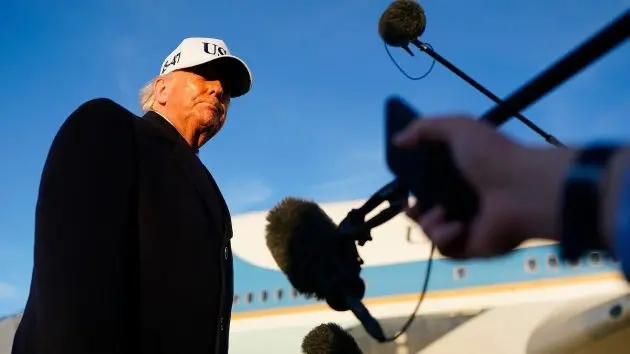
Speaking to reporters on Air Force One on Sunday, Trump said he “didn’t see” the email. “I didn’t see it. I mean, somebody puts it up. We have a lot of people working for us, but there’s nobody that’s better to the military than me,” Trump said.
The Pentagon identified the six service members killed when a U.S. KC-135 refueling aircraft crashed in western Iraq on Thursday.
Three of the Air Force airmen were assigned to the 6th Air Refueling Wing, MacDill Air Force Base in Florida: Maj. John A. Klinner, 33, of Auburn, Alabama; Capt. Ariana G. Savino, 31, of Covington, Washington; and Tech. Sgt. Ashley B. Pruitt, 34, of Bardstown, Kentucky
The other three airmen were assigned to the 121st Air Refueling Wing at Rickenbacker Air National Guard Base in Columbus, Ohio: Capt. Seth R. Koval, 38, of Mooresville, Indiana; Capt. Curtis J. Angst, 30, of Wilmington, Ohio; and Tech. Sgt. Tyler H. Simmons, 28, of Columbus, Ohio
The crash, which involved another KC-135 tanker, is still under investigation.
Oil reserves
Oil reserves from emergency stockpiles will start flowing immediately to Asia but won’t be available to the U.S. and Europe until the end of March, the International Energy Agency (IEA) said in a new press release Sunday.
Importantly, the IEA did not specify exactly how much oil would start flowing per day — a metric oil analysts are watching to understand what the immediate impact might be on prices. Oil prices have so far not been tamed by the announcement that countries, including the U.S., are tapping their strategic reserves.
The IEA announced the biggest-ever release of oil from reserves — 400 million barrels — from its 32 member countries last week. That includes 172 million barrels from the U.S.
Copyright © 2026, ABC Audio. All rights reserved.