(WASHINGTON) — For several years, as U.S. authorities have struggled to stop online extremist networks like “764” from pushing teens to livestream acts of violence or self-harm, including their own suicide, the Justice Department has faced what authorities and victims both say is a vexing challenge: Such coercion is not a federal crime.
That could change if the Republican chairman and the top Democrat on the Senate Judiciary Committee, which oversees the Justice Department, have their way.
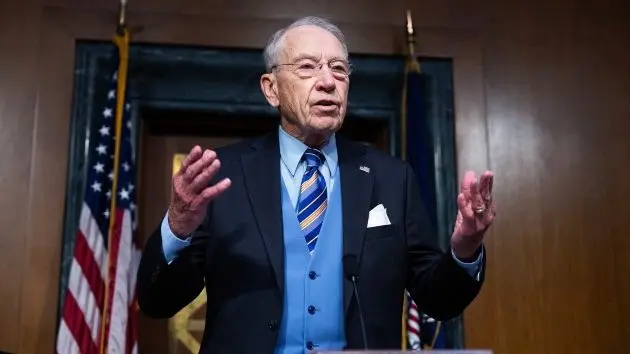
Ahead of a committee hearing Tuesday on the evolving threat of online predators, Sens. Chuck Grassley, R-Iowa, and Dick Durbin, D-Illinois, introduced a first-of-its-kind piece of legislation that would explicitly criminalize the intentional coercing of minors to physically harm themselves or others, including animals.
Under their proposal, called the Ending Coercion of Children and Harm Online Act, some perpetrators could face life in prison.
“When offenders are eventually caught by law enforcement, prosecutors charge them with the most appropriate charges,” Grassley said in the hearing. “However, there are no specific laws to address the terrible and shocking acts conducted by gore groups such as 764 and those engaged in sextortion.”
Grassley and Durbin’s proposed legislation comes in the wake of several recent reports from ABC News about the growing threat of 764, including an extended interview with the parents of Jay Taylor, a 13-year-old from outside Seattle who in 2022 took his own life — and aired it live on social media — after allegedly being manipulated by a member of 764 in Germany.
“It’s almost biblical in its definition of evil, what happened,” Jay’s father, Colby Taylor, said in the ABC News interview. “Ten minutes of murder.”
That’s why the U.S. needs “to have something in our actual laws that allows us to prosecute” cases as “digital homicides,” he said.
The FBI has described 764 as one of the greatest current threats to teens online, with members finding vulnerable victims on popular platforms, eliciting private information and intimate sexual images from them, and then using that sensitive material to blackmail victims into mutilating themselves or taking other violent action — all while streaming it on social media so others can watch and then disseminate recordings of it.
According to authorities, Jay Taylor is just one of many victims pushed to suicide.
German law explicitly criminalizes such coercion, so the young man allegedly behind Jay Taylor’s death — calling himself “White Tiger” online — has been charged in Germany with murder, along with 203 other offenses involving more than 30 other victims.
According to former FBI agent Pat McMonigle, who helped uncover “White Tiger” and what he allegedly did, making online coercion a federal crime in the United States “would be very helpful.”
“This is truly a bipartisan thing that … could effect some change,” he recently told ABC News.
According to Grassley’s office, the Ending Coercion of Children and Harm Online Act — or “ECCHO Act” — would “specifically go after” networks like 764, creating a penalty of up to life in prison for those who intentionally coerce someone into even just attempting to die by suicide or who coerce someone into taking action that results in the death or killing of another person.
The bill would also create a 30-year maximum penalty for other harmful conduct that does not involve a death, Grassley’s office said.
“Because of modern technology, child predators from anywhere in the world can target American kids online,” Durbin, the second-highest ranking Democrat in the Senate as the Democratic whip, said in a statement. “As technology has evolved, so have online child predators.”
The National Center for Missing and Exploited Children says it received more than 2,000 reports of abuse tied to 764 or similar networks in the first nine months of this year.
As ABC News has previously reported, the FBI is investigating more than 350 people across the United States with suspected ties to 764 or similar networks. And the Justice Department has already publicly charged at least 35 such people in recent years.
Their victims have been as young as nine years old, according to authorities.
FBI Director Kash Patel recently called 764 “modern-day terrorism in America.”
The Senate Judiciary Committee’s hearing on Tuesday will include testimony from an executive director of the National Center for Missing and Exploited Children, a former federal prosecutor who retired from the Justice Department earlier this year, and the mother of a teenage son who was victimized by sextortion and then took his own life, unrelated to 764.
Some states have enacted laws aimed at helping to protect children online. And in May, President Donald Trump signed into law the TAKE IT DOWN Act, which prohibits the nonconsensual publication of sexually-explicit images and pushes online platforms to remove violative material.
Several lawmakers — from both sides of the aisle — have introduced additional pieces of legislation in both the House and Senate that could help fight online predators.
But those laws and proposals don’t specifically address the coerced self-harm that is emblematic of 764 and similar online networks.
On Tuesday, Grassley and Durbin are expected to introduce two other pieces of legislation to help protect children online, including the Stop Sextortion Act, which would amend existing laws to address offenders who use threats to distribute sexually-explicit material to extort and coerce minors, according to Grassley’s office.
“I’m proud to introduce these bills to protect children from online abuse, hold dangerous criminals accountable and secure much needed justice for victims and their families,” Grassley said in his statement.
Durbin similarly said he was “proud to join” Grassley’s effort.
At least one other top Democrat in the Senate, Senate Intelligence Committee Vice Chairman Mark Warner, D-Virginia, has previously expressed support for such legislation, recently telling ABC News that online coercion is “a total crime,” even if “it’s through a digital connection.”
Still, it’s unclear how successful Grassley and Durbin’s effort will be.
One high-profile piece of legislation aimed at protecting children online, the Kids Online Safety Act, passed overwhelmingly in the Senate last year — by a vote of 93 to 1 — only to languish in the House, largely due to First Amendment concerns.
“This is a problem that is going to continue to morph, and if we don’t do something, potentially could get worse,” Sen. Warner told ABC News.
Copyright © 2025, ABC Audio. All rights reserved.